


Australian-headquartered Octopus Deploy is quietly redefining how modern organisations, particularly those in highly regulated industries, approach the challenge of software deployment.
Speaking exclusively to TechDay, CEO Paul Stovell laid out the thinking and market forces driving the company's evolution from a weekend engineering side project to a global provider for some of the world's most risk-averse businesses.
Stovell used to work with banks and insurers in both Australia and the UK.
"Deploying software was the bane of my existence back then," Stovell explained during a recent interview with TechDay.
What began as a tool to solve his own deployment headaches has, twelve years on, become a business serving over 4,000 customers worldwide and achieving annual revenues above AUD $120 million.
The target market has never been parochial: "We've been global sort of since day one. In fact, over half of our revenue is from North America," Stovell said, while also pointing to a significant blue chip client base in Australia across financial and insurance sectors.
Stovell described the central challenge facing these organisations: "Prior to Octopus, there weren't really many good options that focused on solving this [deployment] really well."
He drew an analogy with the logistics world: "There's a much more difficult problem sometimes, which is how do we take it from the local distribution centre to all of the houses and businesses down the street." In software, he contended, the emphasis is often mistakenly placed on the visible elements of continuous integration - build automation and running unit tests - while the risk-laden complexity of moving changes into production is frequently left to a patchwork of scripts and brittle manual processes.
At the enterprise scale, these habits are persistent.
Stovell cited examples of banks running bespoke continuous delivery systems developed in-house over two decades.
"What tends to happen is the software developers set up the CI/CD systems, get their unit tests running, and then learn about all the difficulties of moving to production. They start building custom scripts and applications, until eventually they've built their own version of what we solve." For these enterprises, the move to Octopus delivers a transformation not just in process but in mindset: "We move our customers from deploying to production once a month, once a quarter - and that being a very scary, fearful process - to a virtuous cycle where deployments go from 'the worst part of my experience' to just another routine activity."
Much of Octopus Deploy's differentiation, Stovell maintained, came from its focus on the problematic 'last mile' of DevOps, especially in environments with demanding compliance obligations.
"Octopus probably has the richest and deepest support of any continuous delivery system in terms of auditing," he said, highlighting the distinction between the compliance focus at the deployment stage versus the build stage.
"When there's a system that does it and is automated, that compliance angle becomes much easier for people." This capability is at the heart of the company's appeal to major banks, telcos and other regulated entities juggling sprawling legacy estates with modern cloud-native workloads.
Modern IT, Stovell argued, is far more complex than most vendors care to admit: "If you go to any of our customers, you won't just find that they're using Azure. They have all of the clouds, they have local data centres built over many years, deploying to virtual machines, almost any technology invented in the last 30 years - they have that, and they're running it in production."
The reality of this heterogeneity underpinned Octopus Deploy's product roadmap. "We do the best job at spanning all of that. If there's something within your enterprise that you're releasing and deploying software to, and you want to do that in a modern way without modernising every system you have, we're really a great choice."
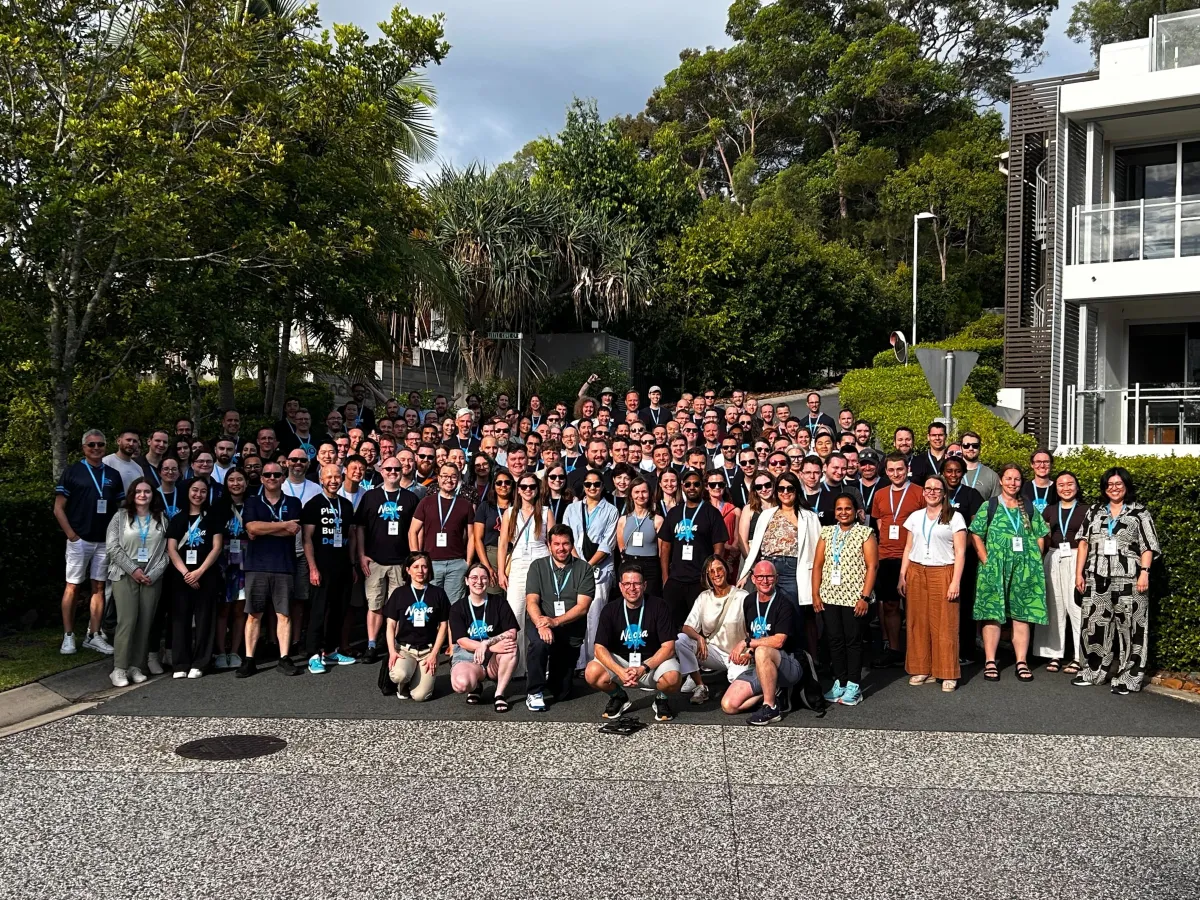
Octopus Deploy Product Kickoff at Noosa, February 2025
The company's roots in Australia and New Zealand were not incidental, but a source of its culture and approach to product.
"If you were to come and join Octopus, there would be a sort of unmistakably Australian vibe... a quiet professionalism, very customer-centric, very down-to-earth. We probably undersell ourselves a little bit," Stovell said, contrasting the company's modesty with what he saw as the "hype" equivalent from North America. However, he was quick to stress that in areas such as customer support and technical depth, Octopus matched the best in the industry.
This philosophy extended to how the business was structured and managed. The company invested heavily in R&D, with just over 180 of its 340 global employees dedicated to engineering and product (70% based in Australia and New Zealand).
"Compared to a lot of North American companies, we tend to be much more heavily focused towards R&D and much less toward sales and marketing… We tend to listen to our customers quite a bit more."
Product development, though increasingly distributed (with nodes in Israel following an acquisition), remained tightly aligned to customer experience and the challenges faced by regulated industries.
Transparency in company operations was a principle as much as a policy.
Octopus ran a publicly available handbook and practiced transparent pay tables - any employee could see the exact salary ranges for each role and level.
"If you're a software engineer at Octopus, you'll know exactly what other software engineers get paid at your level. It's like, full transparency around that." According to Stovell, this policy not only fostered equality but provided clarity and a sense of progression for the team: "People can think, 'OK, today my salary is this. But if I progress in my career, this is where I can get to.'"
In the near future, Stovell anticipates increased demand for automation-driven deployment as AI workloads proliferate and organisational complexity deepens.
"There was probably a world where people might have been a bit sceptical of automating things involved with production deployments," he observed. "The increased compliance requirements make it really hard to audit something done manually in production. But when there's a system that is automated, that compliance angle becomes much easier for people." He pointed to this opportunity as a key driver for Octopus's continued investment in engineering and customer engagement on both sides of the Tasman and beyond.
"For so many of our customers, deployment still isn't a solved problem. Our focus is always going to just be on making that a much, much more seamless process and taking the risk out of it."