

.webp)
Yahoo Boys, a persistent menace and one of the longest running online crime cultures
Fri, 3rd Jul 2026
I've been doing some digging into modus operandi and current capabilities of Yahoo Boys (and for the record Yahoo Girls, too).
Who are the Yahoo Boys? While not a strictly defined group of threat actors, they are people from West Africa, who do fraud and cyber crime online. It's more like a culture of crime, not an organization that pays its employees. This subculture glorifies and normalizes scamming, has its own vocabulary to describe different forms and techniques for scams, and even has its own influencers. Yahoo Boys originated from Nigeria, and they've been an online menace and threat since late 1990s, making them one of the oldest and most resilient online crime cultures.
The reason why Yahoo Boys came to be, is incredibly complex mix of societal, cultural and (geo)political factors. I'll give a very brief history recap, but please acknowledge that there's of course more to the story.
In 1970s, Nigerian Oil boom was a period of massive wealth influx. Oil prices skyrocketed due to Arab-Israeli war in 1973, making Nigeria the wealthiest nation in Africa. However, oil prices crashed in 1980s, which led to a situation where suddenly there were many highly educated young people in Nigeria, with no real future job prospects.
In late 1990s and early 2000s, internet cafe's (or cybercafes) started to become popular in major commercial cities and urban centers. They soon gained popularity and resulted in a lot of good things for Nigerians: offered a way to connect with governmental services, keep in contact with friends and family, as well as all of the educational and professional capabilities that internet connectivity enabled.
But as with all good things, cybercafes had a usage for people on the dark side too. Yahoo! was the "online portal" for many who connected to the internet for the first time. Yahoo! email was one of the most popular ways to connect to people worldwide.

Figure 1Yahoo! Website from 2000s. Screenshot taken from Internet Archives.
Because everyone was online for the first time ever, it meant that no one had the templates for "what is online scamming" or "this is what a malicious email is like". This was quickly realized by a small group of people in Nigeria, who started to experiment with scams in form of email: often promising hefty sums of money in a form of inheritance, only if the recipient would first send over an advance payment, bank account details, passport details and so on.
Yahoo Boys became the commonly used name for people who sent out emails like this, because they used Yahoo! email. And we assumed they were boys, even though at least today I was able to find evidence of women who are scamming just the same… so yeah, online crime is not only for guys!
The scam where advance payment is requested for large sums of money, are probably one of the best known scams worldwide. Often (slightly unfairly) dubbed as "Nigerian Prince Scams", these advance fee scams are some of the oldest forms of cyber crime online.
The first iterations of the scams often involved a mention of a wealthy prince in Nigeria, hence the name Nigerian Prince Scam has stuck. However, it's not necessarily fair to dub a whole category of scams (advance fee scams) under a specific region or nation, especially as today asking for a payment in advance is a common blueprint for many different threat actors.
Today, we all recognise a scam when we see an email that's offering millions of dollars/euros for free. Some experts claim that "there are still people falling for email-based advance fee scams", but I'm sure this is only a handful of people, also because email filters today are so much better. But that doesn't mean that these scams have historically been unsuccessful - quite the opposite. I suspect that millions have been made with "simple" scams like these.
So are Yahoo Boys and Yahoo Girls now a thing of the past thanks to increased awareness and email filters? Not at all.
Remember the Brad Pitt deepfake scam? A french woman who fell in love with a person she thought was Brad Pitt and lost her marriage and her money. Who was behind this scam? Yahoo Boys.
Or what about deeply scarring sextortion scams where young people are being blackmailed with the nudes they shared with a person they thought was their intimate partner? Yahoo Boys. Sometimes they never even share a nude, but their pictures are used to generate deepfaked nudes (or "deepnudes").
Some of the most discussed and gut-wrenching scams of today are done by the members who subscribe to Yahoo Boys subculture.
Yahoo Boys have demonstrated over the years how resilient they are. When email filters became better, they moved to social media and instant messaging apps. They use dating apps, even target local dating apps in different countries. I even saw a Finnish-speaking Suomi24 Treffit mentioned in one Telegram channel that was listing potential places where to find people to scam.
Yahoo Boys are also adept at using AI: an influencer named Format Boy is for example sharing tutorials (or "tuts" in Yahoo Boys lingo) on YouTube for how to create deepfake video call filters. Telegram channels for Yahoo Boy "research" (or "updates" as they call them), list different apps for generating deepnudes and so on. I also found one "central" Google Drive used by them to share template text for scams, as well as multiple Scribd uploads.
Speaking of lingo and vocabulary, Yahoo Boys call template texts "formats". It's a term used for the sample and template texts that can be copy-pasted by others when they chat with victims in dating apps, social media or instant messaging apps. In the following paragraphs, I'll be referencing to these "formats" as scripts and templates.
Some of the most concerning things I came across while researching today's capabilities for Yahoo Boys, is how they share scripts how to blackmail people. Some of these blackmailing scripts are sextortion scripts, which follow the pattern also observed by victim testimonials. They basically coerce the victim into sending a nude image of themselves, often taken via a mirror (see attached image, it has some very crude language).
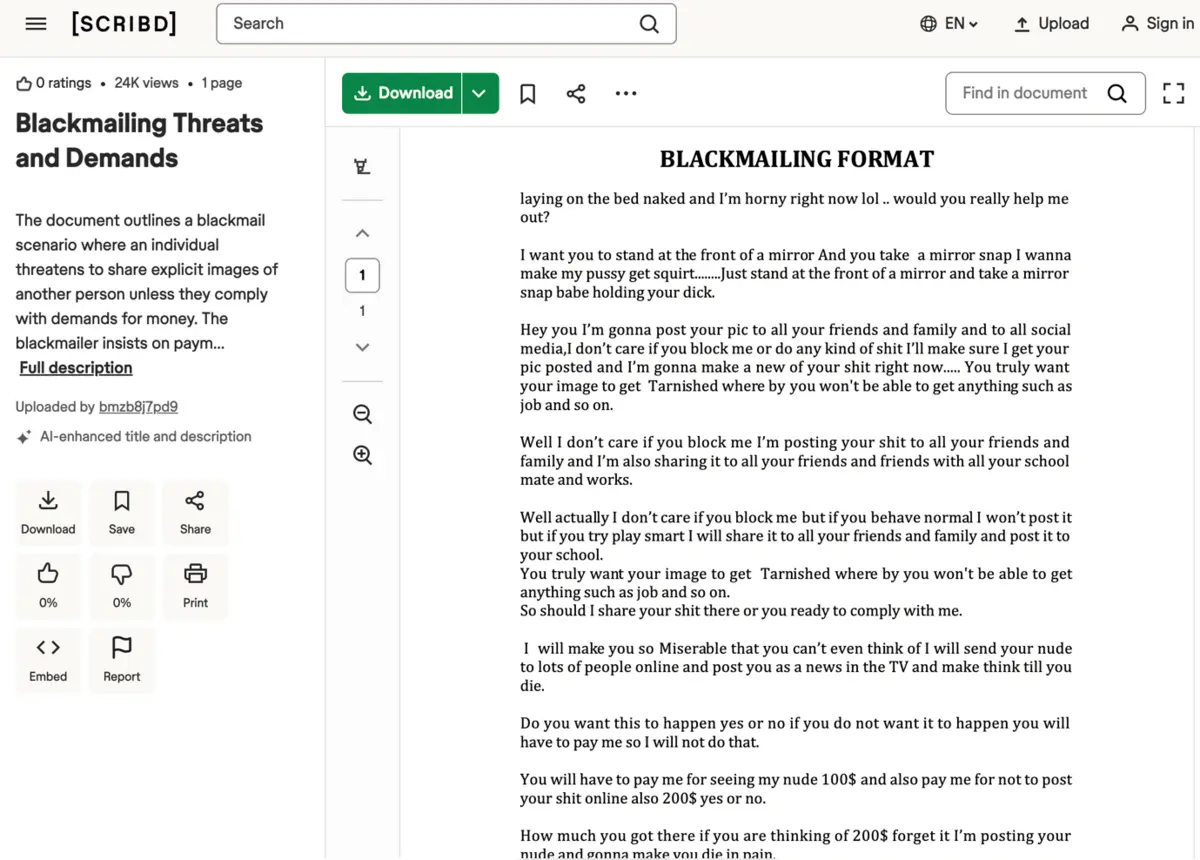
Furthermore, I found scripts for pretending to be an FBI Agent and Fox News journalist that have discovered nudes of the person. The idea is to scare the person into paying that their nudes won't be leaked, or that the FBI can remove the nudes.
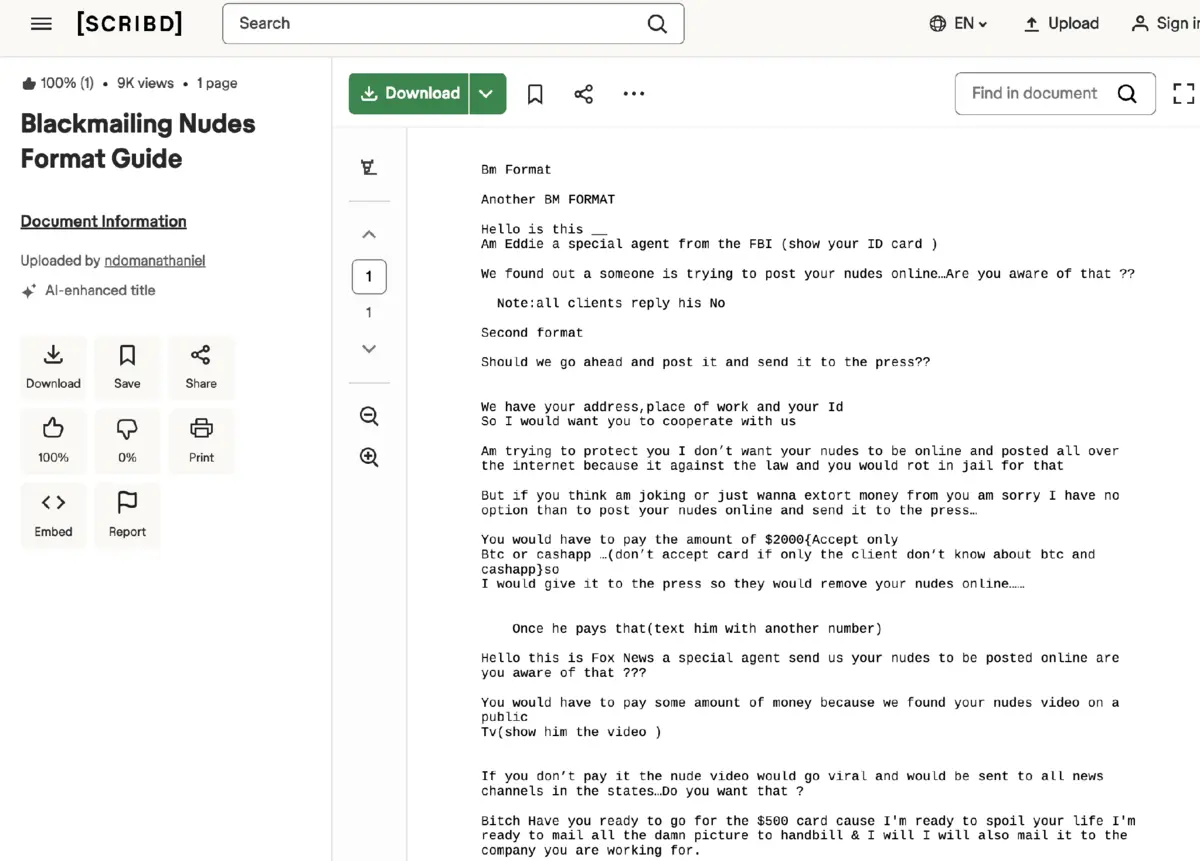
Figure 8 Blackmailing with leaked nudes, pretending to be an FBI agent and/or Fox News special agent
There were also blackmailing templates for "assassination attempts". I.e. victim's safety and life is in danger, if they don't pay up. I don't think these have been discussed that much in public, but I'm sure these are also in circulation online. Blackmail messages like these are scary, I wouldn't be surprised if someone ended up paying the ransoms.
The ransom demands on the templates range from 50$ to up to 500$, but of course the Yahoo Boy who's doing the scamming might adjust the price to whatever they see fit. Especially sextortion scams are targetted at younger people, hence the ransom demands are "in line" with what the victim is expected to be able to pay.
Recently, Yahoo Boys have been reported to set up "Hustle Kingdoms" where they teach others how to scam. In the recent years, some of the Yahoo Boys have also been involved in dabbling with "dark magic" and rituals, involving kidnappings and even killings, in order to improve the chances of successful scams.
It is clear that Yahoo Boy crime subculture is causing a lot of harm, not only globally, but to Nigerians as well. I've seen many videos and columns by Nigerians, who criticize the crime culture that causes reputational damage to their home country. Obviously, there's a disdain for people whose main job is to scam people.
Most important for us is also to remember that even though Yahoo Boys subculture is often associated with Western Africa and Nigeria, it is not a culture that represent the majority of people in that region. Similar online crime subcultures (and even more organized ones!) can be found all around the world.
The idea that you can get rich quick and it's okay to harm others to accomplish that, is unfortunately global. Cyber criminals can exist in every country. They can be someone we know, someone who lives next door.
To conclude, I want to reiterate that Yahoo Boys and Yahoo Girls are still very much online, and actively spreading knowledge and, despite more strict laws being enforced in Western Africa, they still flex their successful scams online. The culture shows interesting resilience: they pivot to other online services and pioneer how bad use of AI looks like.
Thank you if you read all the way down here!