

SUSE targets Australia's sovereignty rules with AI roadmap
Thu, 20th Aug 2026
SUSE has released a digital resilience report and outlined an Australia-focused roadmap for compliance, AI and edge computing, aimed at enterprises dealing with sovereignty and cybersecurity rules.
The report found that 98% of IT decision-makers and leaders see digital sovereignty as critical. A flash poll of Australian IT leaders found 90% are increasing AI budgets. Yet compliance hurdles are holding back 43% of enterprise AI projects, according to SUSE's local polling.
The findings come as Australian organisations face tighter scrutiny under the Security of Critical Infrastructure Act, the Essential Eight framework and the federal government's whole-of-government cloud computing policy. SUSE cast those mandates as a practical challenge for infrastructure planning, data control and where computing workloads are located.
Central to its message is the view that sovereignty has shifted from a policy discussion to an operational issue. Businesses are increasingly being asked to show where data resides, how systems are governed and whether infrastructure can meet audit and security requirements without forcing broad changes to existing technology estates.
SUSE said it is addressing that challenge with software for data centres, cloud environments and edge deployments. It highlighted built-in zero-trust security, immutable infrastructure and software bills of materials as part of its compliance case for customers in regulated sectors and critical infrastructure.
Another focus was the gap between AI experimentation and production use. SUSE said Australian companies are still willing to invest in AI but are struggling to move projects into live environments when data handling, governance and regulatory controls are not settled early.
SUSE AI Factory with Nvidia was its main example. The company said the product combines Nvidia AI Enterprise with SUSE's governance layer and can reduce AI deployment times from months to days while keeping data inside customer-controlled environments.
That emphasis on local control reflects a broader market shift as enterprises try to avoid moving sensitive information across borders or into systems they cannot fully govern. It also reflects growing concern over cost control, hardware use and flexibility as AI workloads become more demanding.
SUSE also pointed to its broader infrastructure portfolio, including Linux, cloud-native and edge software, as a way for customers to manage workloads across multiple environments. The approach is intended to give organisations control over where data resides while supporting resilience across on-premises systems, cloud platforms and remote sites.
Local awards
Alongside the report findings and product roadmap, SUSE recognised Australian and regional customers and partners for projects tied to sovereignty, AI and infrastructure modernisation.
Datacom was recognised in the Secure Edge category. SUSE said the company modernised a critical national system in New Zealand using a cloud-native architecture designed for edge deployment, security controls and near-zero downtime across remote sites.
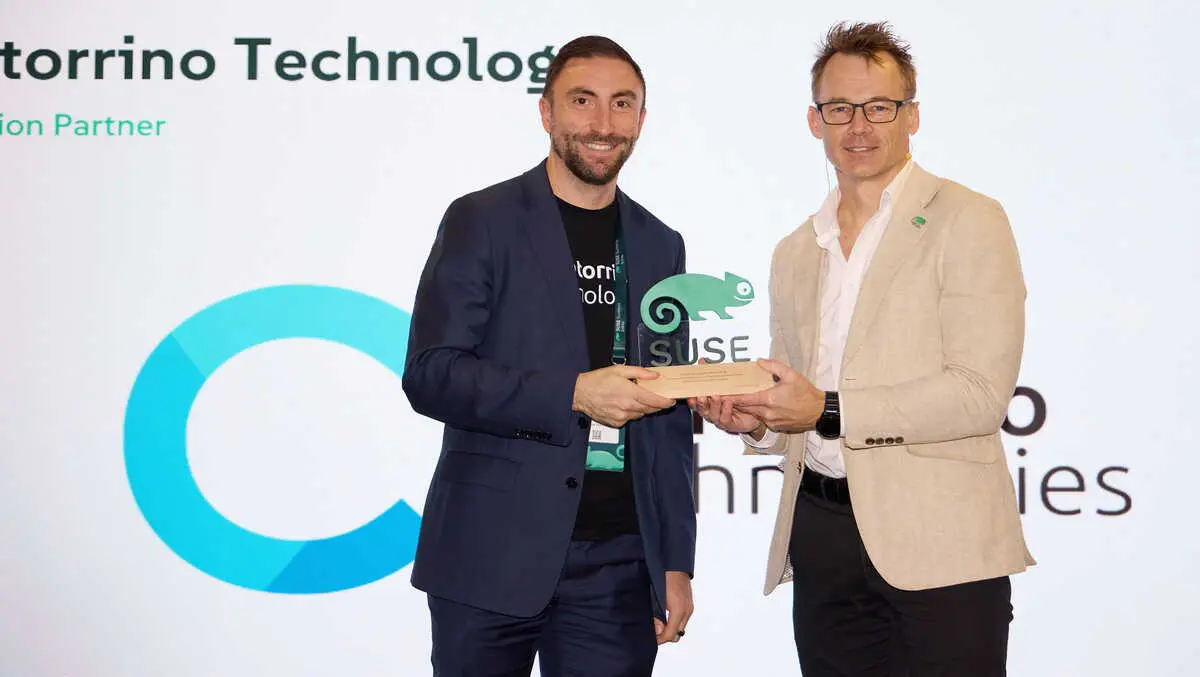
HPE was recognised in the Growth Partner category, while Centorrino Technologies received the Innovation Partner award. According to SUSE, HPE worked with it on hybrid cloud and AI infrastructure for Australian customers, while Centorrino migrated its own systems to SUSE and built a virtualisation offering around direct moves to Kubernetes.
Datacom's project was presented as an example of how sovereign data control and edge deployment can be combined in national-scale systems. The work used the SUSE Rancher platform, including RKE2, Rancher Prime and Rancher Storage.
"Modernising critical infrastructure demands a platform that delivers both rigorous security and the flexibility to operate at the edge. By standardising on the SUSE Rancher platform, Datacom has successfully deployed a cloud-native architecture that ensures near-zero downtime and sovereign data control. This foundation has been essential to our mission, enabling us to support government and commercial clients with the operational independence and resilience required to manage services at a national scale," said Santana Faint, Director for Customer Delivery & Modern Platforms, Datacom.
SUSE's Australia and New Zealand business said the compliance burden is colliding with pressure on AI roll-outs and infrastructure budgets. It also linked the issue to rising data centre energy costs, arguing that enterprises are looking more closely at how to use existing hardware efficiently.
"Australian enterprises are navigating a pressurised landscape: they must scale AI to remain competitive while meeting strict regulatory mandates like the SOCI Act and Essential Eight. With compliance hurdles currently stalling AI projects, and rising data centre energy costs squeezing hardware resources, 'innovation as usual' is no longer viable. Open source is now the critical infrastructure mandate-it provides the lowest memory footprint, enabling businesses to maximise the hardware they already have. By adopting sovereign models underpinned by open standards, organisations can navigate evolving legislation, optimise their existing investments, and retain full freedom over where and how their data runs," said Ben Henshall, General Manager A/NZ, SUSE.
HPE framed its award as a sign of customer demand for AI infrastructure that can meet local governance requirements. "Being named a SUSE Strategic Partner reflects our shared commitment to helping Australian organisations build and scale AI with confidence. By combining HPE's hybrid cloud and AI infrastructure capabilities with SUSE's open source expertise, we can provide customers with the validated, sovereign platforms they need to reduce complexity, accelerate deployment, and realise value from their AI investments in an increasingly regulated environment," said Rohan Cook, General Manager Channel & Partner Ecosystem, HPE South Pacific.