


Data governance vs. data quality: Which comes first in 2026?
Thu, 26th Mar 2026
Let's be blunt.
You can have the most sophisticated data governance framework in existence. You can have a steering committee with C-suite representation. You can have data stewards in every business unit, a meticulously maintained business glossary, and lineage diagrams that look like works of modern art.
But if the data itself is unreliable, none of it matters.
Governance without quality is not governance. It is bureaucracy dressed in corporate branding.
The organizations that are winning in 2026 understand this distinction with painful clarity. They have moved beyond the checkbox mentality of "we have a governance program" and embraced a harder truth: quality is the only metric by which governance should be judged.
The Illusion of Governed Garbage
Here's a scenario playing out across enterprises today.
A global financial services firm spent eighteen months building a governance program. Roles were defined, policies documented, and a data catalog deployed. Leadership declared it a success.
Six months later, a regulatory audit revealed that customer risk scores used for compliance reporting were based on incomplete and inconsistent data across systems.
The firm faced fines and a harsh realization: they had built a strong framework - but on unreliable data.
This is the trap. Governance frameworks can create the appearance of control while leaving the actual quality of data unaddressed.
In 2026, with AI models ingesting data at scale and regulators demanding verifiable accuracy, that illusion is more dangerous than ever.
Quality Is Not a Pillar of Governance. Quality Is the Proof.
In traditional data management literature, data quality is often listed as one of several pillars under the governance umbrella - alongside metadata management, security, and compliance.
This framing is a mistake.
Quality is not one pillar among many. Quality is the functional output that validates whether the governance framework is actually working.
Consider this distinction:
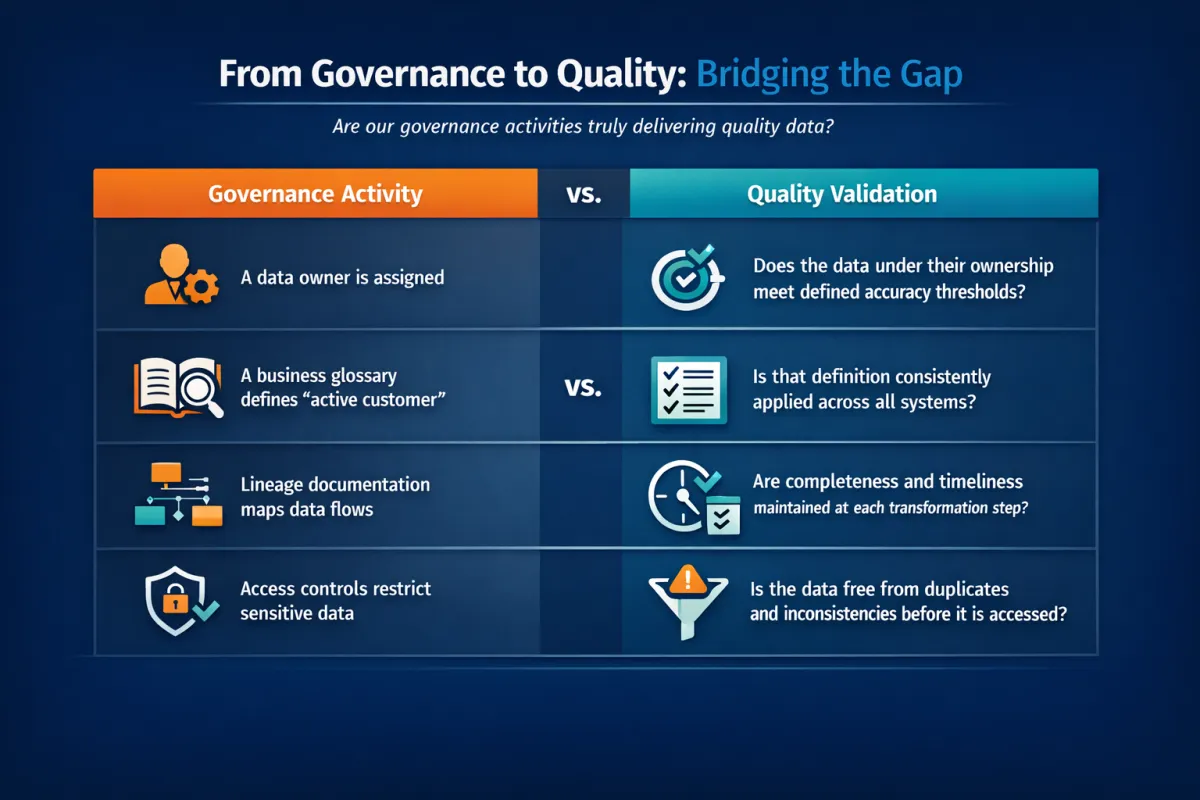
Governance provides the structure - roles, definitions, policies, accountability. Quality provides the evidence - proof that the structure is producing trustworthy data.
Without quality metrics, governance is an act of faith. With them, it becomes an act of management.
The 2026 Reality: Quality Must Be Continuous, Not Periodic
One of the most common failure modes in enterprise data programs is treating quality as a project.
A team is assembled. Data is profiled. Issues are identified. A remediation effort cleanses critical datasets. Reports are generated. The project closes. Everyone celebrates.
Six months later, the data is degraded again. New sources have been added. Business processes have changed. System upgrades introduced inconsistencies. The quality project delivered a snapshot of cleanliness, not a sustained state of trust.
In 2026, leading organizations have abandoned the project mindset. They have embedded quality into operational workflows:
- Automated profiling runs against every new data source at ingestion, flagging anomalies before they propagate
- Continuous monitoring tracks quality dimensions - accuracy, completeness, timeliness, consistency - on a schedule that aligns with business criticality
- Self-healing pipelines automatically apply standardization and deduplication rules without manual intervention
- Quality SLAs are defined for every data product, with automated alerts when thresholds are breached
This shift from periodic to continuous quality is what separates organizations that trust their data from those that merely hope it is usable.
The Cost of Separating Governance and Quality
Many organizations still operate with governance and quality as separate functions. Governance sits in a central office, focused on policy and compliance. Quality sits within IT or data engineering, focused on tooling and remediation.
This separation creates predictable failure patterns:
- Governance defines policies that are technically impractical to enforce
- Quality teams remediate issues without understanding business context or priorities
- Accountability becomes diffuse - governance says quality is an IT responsibility; IT says governance should have prevented the problem
- Business users lose confidence in both functions
In high-maturity organizations, this separation has been eliminated. Governance and quality are unified under a single accountability model, with shared tooling, shared metrics, and shared incentives.
A New Framework: Governance as the Enabler of Quality at Scale
If governance without quality is bureaucracy, what is the alternative?
The alternative is a framework where governance exists to enable quality at scale. Here is how that works in practice:
1. Governance defines the rules. Quality automates enforcement.
Governance establishes what "quality" means for each data domain - acceptable accuracy rates, required completeness thresholds, timeliness requirements. Quality tooling then automatically validates against these rules, continuously and without manual effort.
2. Governance establishes ownership. Quality enables accountability.
A data owner without visibility into quality metrics cannot be meaningfully accountable. Governance assigns ownership; quality dashboards provide the visibility that makes ownership actionable.
3. Governance documents context. Quality validates fitness.
A data catalog with rich metadata is valuable, but it only tells users what data should be. Quality metrics tell users what data actually is. Together, they enable confident decision-making.
4. Governance ensures compliance. Quality provides evidence.
Regulators are increasingly asking not just for policies, but for proof of effective controls. Quality monitoring produces the audit trail that demonstrates compliance is real, not theoretical.
Where Organisations Should Focus in 2026
If your organization is looking to strengthen the connection between governance and quality, here are three priorities for the year ahead:
Prioritize quality for AI consumption. AI models amplify whatever is in your data. If your data has hidden biases, inconsistencies, or gaps, your AI will inherit them. Governance frameworks should prioritize certifying datasets for AI use with verified quality scores and complete lineage.
Unify governance and quality tooling. Disparate tools create disjointed workflows. The most effective implementations use integrated platforms where governance policies flow directly into quality rules, and quality metrics feed back into governance dashboards.
Shift left. The earlier quality is validated, the cheaper it is to fix. Embed quality checks at data ingestion, transformation, and consumption layers. Don't wait for a quarterly governance review to discover that critical data has degraded.
Conclusion: Trust Is Not Optional
In 2026, data is not just an asset. It is the foundation of competitive advantage, operational efficiency, regulatory compliance, and AI-driven innovation.
Organisations that treat governance and quality as separate initiatives will find themselves with beautiful frameworks and untrustworthy data. They will experience the worst of both worlds: the overhead of governance without the benefits of quality.
Organisations that unify governance and quality, using governance to enable quality at scale and quality to validate effectiveness, will achieve something far more valuable than compliance or documentation.
They will achieve trust.
And in a world where decisions are increasingly made by algorithms and AI, trust is the only currency that matters.
The question is no longer whether you have governance - it's whether you can prove your data is trustworthy.
Discover how modern data quality and identity solutions can help you build trust into every data workflow. Learn more.