

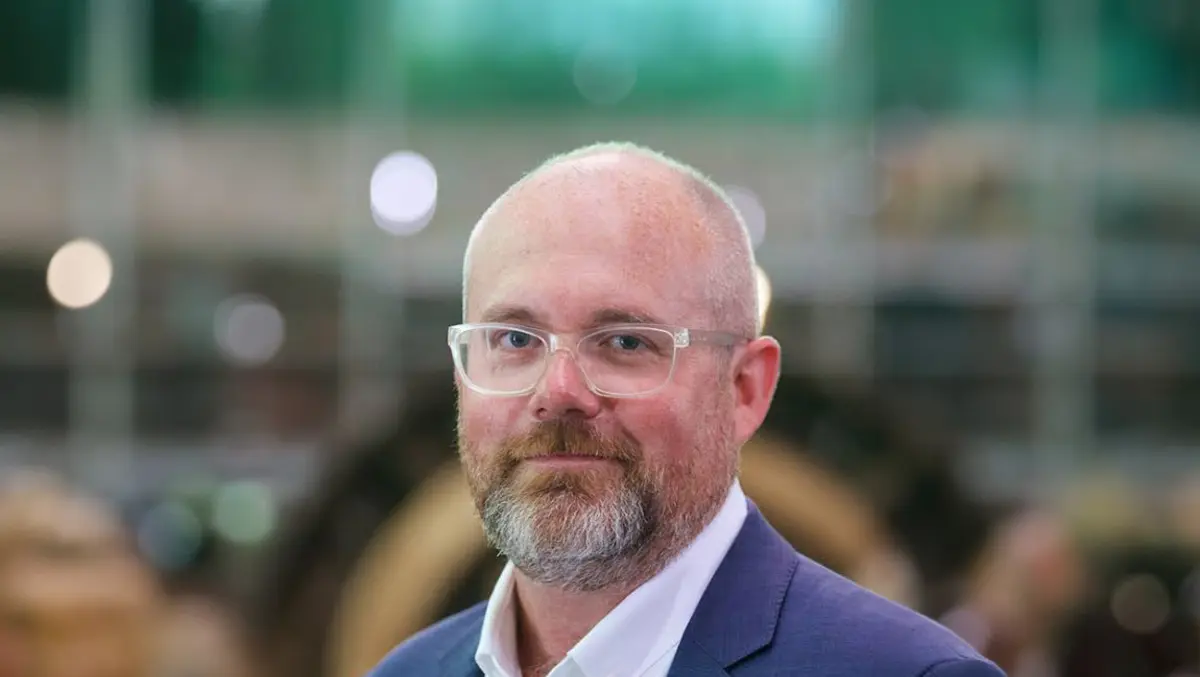
Senator Tim Ayres promises 'resilience' as Australia shapes AI path
Wed, 20th Aug 2025
Australia's Industry and Science Minister, Senator the Hon Tim Ayres, says artificial intelligence represents a once-in-a-generation opportunity for the nation but warns that regulation must be "careful" and "precise" to protect the public interest.
During an address to a room of technology journalists over the weekend, Ayres set out his vision for Australia's digital future and addressed questions on regulation, copyright, jobs and regional cooperation.
"I grew up in regional NSW on a family farm that bore no resemblance to corporate Sydney, let alone Silicon Valley," he said.
"But as a teenager in the 1980s, I keenly watched the Hawke Labour Government lead the world with its unique blend of profound transformative economic reforms and inclusive, supportive social policies."
Ayres drew on his experience in the Australian Manufacturing Workers' Union, where he saw workers adopt new technologies to drive productivity.
"Each wave of technological change, whether robotics, automation or digital technology, presented new challenges," he said. "But Australia met that challenge successfully."
Now, he argued, the country faces an even bigger shift.
"AI and quantum technologies will revolutionise production as the steam engine or electricity did a couple of centuries ago," he said. "If adopted strategically, these technologies present an unmissable opportunity from which all Australians can benefit together."
Asked about the government's approach to legislation, Ayres stressed caution.
"We will determine our approach to this carefully. Regulation requires precision and the capacity to deal with bad outcomes in a way that supports the overall national interest," he said. "We're going to take our time to work through those questions." He emphasised that investment in digital infrastructure, adoption of AI across the economy and support for the technology sector were immediate priorities.
When questioned about criticism from Senator David Shoebridge, who suggested he lacked interest in technology policy, Ayres responded: "I haven't read his comments. That is his view," he said. "What I'm focused on is making sure that Australia leans into the opportunity. We are in a strong strategic position to adopt these technologies in a thoughtful way to secure our future economic resilience."
He was asked whether government would move to address copyright disputes over AI training.
Ayres was clear: "We have no plans to alter copyright laws in either direction," he said. "Unlike some other jurisdictions, copyright law in Australian law applies now. There are no plans to alter copyright protections or broader rights for Australians."
On questions about foreign technology dependence, Ayres linked cyber security and AI capability to broader industrial policy.
"Our ambition, underpinned by $22.7 billion worth of production credits and tax credits in the iron ore sector, is to move up the value chain," he said. "I see that in very similar terms to the way we're approaching emerging technology. It does require coordination, but what you're seeing with this government is a collective sense of purpose."
Concerns about AI job losses were also raised. One journalist cited a worker made redundant specifically due to AI. Ayres acknowledged the risk but called for dialogue. "The Jobs and Skills Australia report suggests it's more likely jobs will be augmented rather than replaced," he explained.
"The answer is more dialogue, not big predictions, and careful practical work at the workplace level to make sure the benefits are shared." He said unions and employer organisations had a role to play. "While there's a cartoon drawn about their positions, my experience is there's a clear sense the technology is coming through and we need cooperative relationships," he said.
On the National Reconstruction Fund, Ayres said a new statement of expectations had been issued.
"It's about lifting the level of ambition, setting targets and supporting our objectives in mandated areas," he said. The fund had already invested in AI firms to build domestic capability, though he stopped short of outlining future mandate changes. He also highlighted a forthcoming strategic review of research and development. "I'm really looking forward to that report being a springboard for future activity and alignment in terms of science and innovation," he said.
Ayres admitted more work was needed to support Pacific nations in adopting AI.
"It's a really good question, and I don't have a good enough answer today," he said. "But this government has demonstrated a thoughtful commitment to the rights and resilience of Pacific states, and that must extend to technological development."
On international policy, he said Australia would not simply follow European or American approaches. "We will develop an Australian approach that's in the national interest, given our conditions and capabilities," he said.
Asked about strengthening the cybersecurity workforce, Ayres said the government was considering further support.
"I'm also interested in what we can do with our partners to lift the skills and capabilities of Australians," he said.
"Some of the debate acts as if, as Australians, we don't have agency. The truth is, any new technology is shaped by humans, and I want Australians approaching it with the skills and confidence to tackle it."
He added that public confidence would also be essential.
"Australians are more sceptical than some other countries, shaped by our experience with previous waves of technology," he said. "But the same time as there's scepticism, there's also a very high level of adoption."