

Rescue dog teams join Victorian network for safer searches

Two Victorian volunteer search-and-rescue dog organisations have joined the Victorian Radio Network, giving handlers direct radio access to the state's primary emergency services during searches in rugged and remote terrain.
Australian Search and Rescue K9 and Search and Rescue Dogs Australia now use Motorola Solutions APX 8000 portable two-way radios on shared channels with agencies including police. The change is expected to improve coordination during missions that extend beyond mobile coverage and into difficult conditions.
Search-and-rescue dog teams often deploy into dense bushland and isolated areas where communications can be unreliable. Access to a statewide radio network puts them in the same communications environment as frontline responders, reducing delays when teams need to share field updates.
Angelica Suarez, President of Australian Search and Rescue K9, said the upgrade reflects the realities of time-critical searches in thick vegetation.
"Our dogs are trained to search through thick bushland to locate missing persons, often in highly challenging and time-critical situations," said Angelica Suarez, President of Australian Search and Rescue K9. "These new radios enable us to communicate securely with police and other emergency services, significantly improving safety for our members and our effectiveness in bringing loved ones home."
Network access
The Victorian Radio Network is used statewide for public safety communications. Adding volunteer dog teams extends interoperable coverage to specialist search assets that typically work alongside police and other emergency services during missing-person incidents.
The APX 8000 is a portable two-way radio designed for public safety users. For handlers, it provides a rugged communications option for field use, built to handle bad weather, rough handling, and long periods away from base.
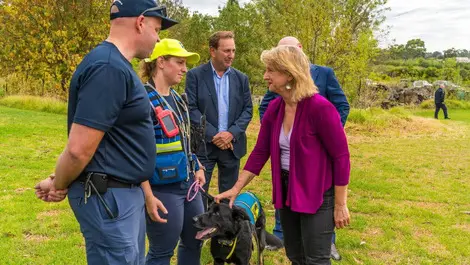
Representatives from Victorian emergency services and Motorola Solutions attended an event at the Australian Search and Rescue K9 headquarters to mark the handover of the radios. Images from the event included Victoria's Emergency Services Minister Vicki Ward.
Recent search
The organisations pointed to a recent operation using the shared radio channels. Dog teams found items belonging to a missing woman, and police later located her safe and well at a remote location.
Con Balaskas, Managing Director of Motorola Solutions Australia and New Zealand, said resilient communications help agencies coordinate during high-risk incidents.
"Providing these exceptional search and rescue dog teams and public safety agencies with resilient communications helps them to work safely and efficiently, coordinating their responses when it matters most," said Con Balaskas, Managing Director, Motorola Solutions Australia and New Zealand. "This collaboration has already proven its value; in one recent search, rescue dog teams located critical items belonging to a missing woman, leading police to find her safe and well at a remote location."
Volunteer dog teams are a specialist resource in missing-person responses. Dogs can track scent and search large areas where visibility is limited and terrain slows human searchers. Handlers and support crews often operate for many hours and work with police incident controllers, field teams, and air support where available.
Clear communications sit at the centre of that coordination. Search teams need to share grid references, request support, manage safety warnings, and receive updates as the search area changes. In remote regions, mobile phones can be limited by coverage gaps, congestion, or power issues, increasing the value of dedicated radio networks for operational traffic.
Contract backdrop
The expansion of Victorian Radio Network users follows the Victorian government's 10-year contract extension with Motorola Solutions to maintain and enhance emergency communications across the state. The agreement supports ongoing operation of the radio network used by many public safety agencies.
For volunteer search organisations, access to the same channels used by first responders reduces the need to relay messages through intermediaries. It can also simplify tasking when multiple organisations converge on a single incident across wide search areas.
The two organisations will continue training and deploying across Victoria with the new radios in service, working alongside police and other emergency services during future searches.