

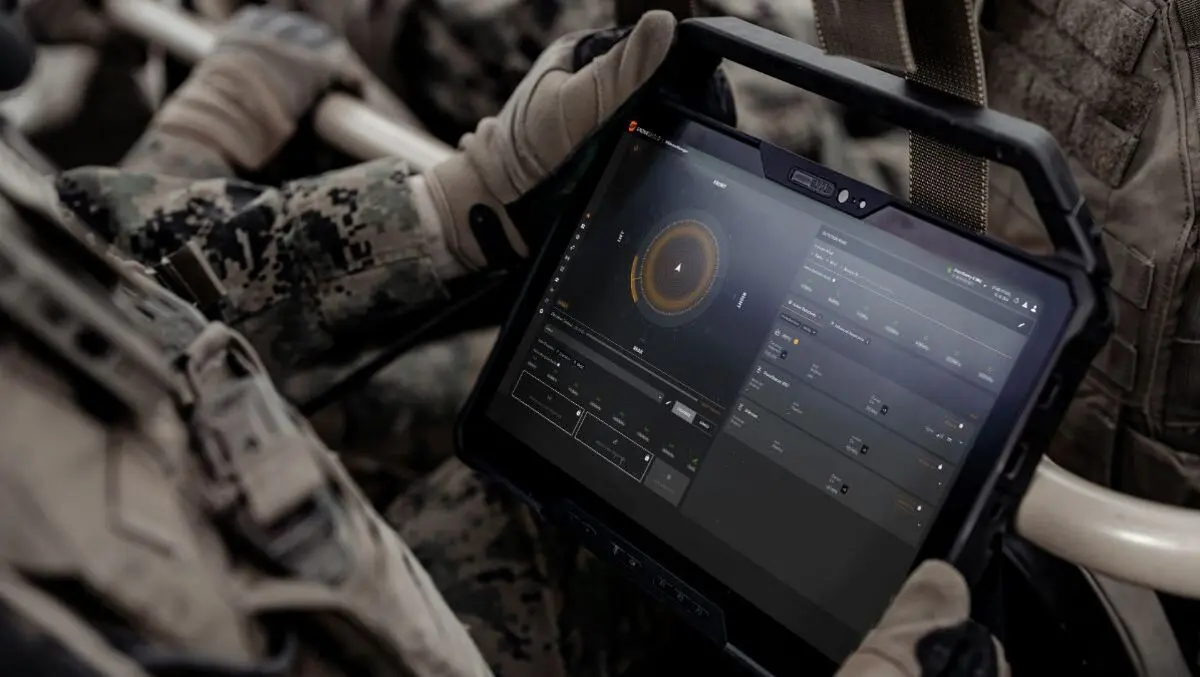

DroneShield has released its Q2 2026 software update for its counter-drone products, covering the group's RF sensing, artificial intelligence, ATAK-CIV plugin and command-and-control systems.
The centrepiece is a new identification and prioritisation framework that automatically classifies drones as Friendly, Neutral, Hostile or Unknown. Using serial-number-based identification and Remote ID inputs, it applies those labels across sensor, ATAK-CIV and command-and-control environments.
The framework is intended to surface the most relevant threats first while suppressing lower-value or background signals, reducing operator burden in fast-moving airspace where multiple detections can crowd screens and slow decisions.
ATAK update
The release also relaunches DroneShield's ATAK-CIV plugin under the name RfLink. Rebuilt to let teams share RF detection data and identity information in real time across distributed users, the software includes line-of-bearing rendering and directional awareness through DroneSentry-X Mk2, as well as Cursor-on-Target data sharing across users and devices.
Identity tagging and classification rules can also be carried through the system, giving users a consistent view of the RF environment.
ATAK-CIV users can receive data from RfLink users without installing the plugin themselves. The software is designed to maintain a shared picture across remote areas, dispersed teams and more difficult terrain.
DroneShield has also added Wi-Fi filtering and revised overlay management to reduce visual clutter, helping operators stay focused on higher-priority threats rather than background signals.
Sensor changes
The update also brings changes to RfDeviceManager, known as RfDM, and RfAI embedded software, including a redesigned interface and updates to detection intelligence at the sensor level.
The new interface keeps detection and disruption data visible while users adjust settings. Its design is more closely aligned with the interface used in DroneSentry-C2, which could reduce training requirements for operators moving between systems.
Additions include a larger RfAI emitter library with new drone and controller profiles, along with improved Remote ID performance and stability. The release also introduces emitter prioritisation to reduce low-value signals and disruption power control by frequency band.
That frequency-band control is intended to let operators calibrate responses more precisely in regulated or sensitive environments, particularly in urban settings and areas where response options are subject to tighter controls.
C2 platform
DroneShield has also updated its DroneSentry-C2, DroneSentry-C2 Tactical and DroneSentry-C2 Enterprise products, with changes focused on deployment flexibility and airspace visibility.
Operators can now use offline MBTiles maps, allowing deployment in disconnected or bandwidth-limited settings such as expeditionary missions, border operations and remote infrastructure sites.
The command-and-control systems also now support dedicated fixed-wing drone classification across VisionAI and SensorFusionAI, reflecting the wider use of fixed-wing platforms in longer-range missions and in military and asymmetric threat settings.
Additional changes include broader support for radar and third-party sensors in C2 Tactical, automatic map orientation for on-the-move navigation, revised SMS alert formatting and Microsoft single sign-on integration for enterprise users.
DroneShield is an Australian-listed company with headquarters in Sydney and Warrenton, Virginia. It sells counter-drone products to military, government, law enforcement and critical infrastructure customers.
The latest software release is available across the company's sensors, effectors and DroneSentry layered defence products, with support for Android 10 and above and ATAK CIV 5.6 and above.